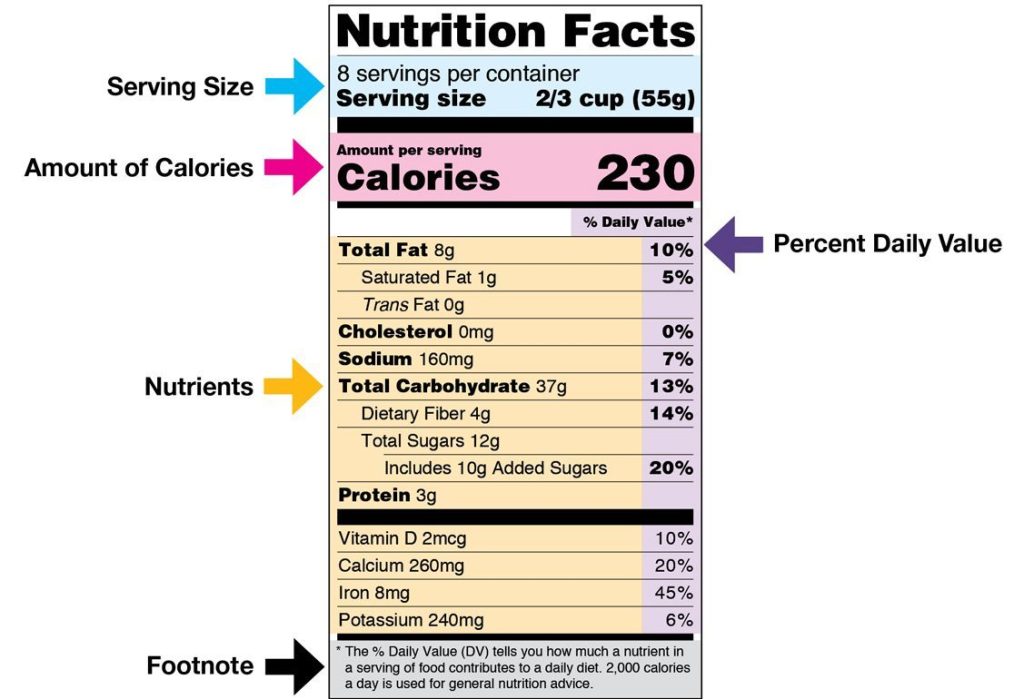
Nutrition labels are everywhere, but let’s be real, they can feel like a foreign language if you’ve never been taught how to read them. Whether you’re trying to eat healthier, track macros, or just understand what’s going in your body, this quick guide breaks it all down.
Let’s walk through the five key parts of a nutrition label with practical tips.
1. Serving Size vs. Servings Per Container
Start here, it’s the foundation.
The serving size is the amount the label’s numbers (calories, nutrients, %DV) are based on, shown in familiar units (e.g., cups, pieces) and grams.
Don’t get tricked: That “single-serve” bag might have 2+ servings. Always check the servings per container!
A bag of trail mix lists a serving as ¼ cup (28g) with 3 servings per bag. Eat the whole bag? Triple the calories and nutrients.
Use a measuring cup or scale for accuracy until you get the hang of eyeballing portions.
2. Calories: Energy, Not the Enemy
Calories tell you how much energy you’re getting per serving, not per package. So if a bag has two servings and you eat it all, double those calories.
But here’s the thing: calories alone don’t tell the full story.
Ask yourself: What are those calories made of. Are these calories from nutrient-packed protein or fiber, or just sugar and fat? Quality matters.
A 200-calorie granola bar high in added sugars isn’t as filling as 200 calories of Greek yogurt with fruit
Pair calorie info with nutrient details to make smarter choices.
3. Nutrients: What to Look For (and Limit)
This is where you figure out if what you’re eating is nutrient-dense or mostly empty calories.
Get more of these:
- Dietary Fiber: Aids digestion, keeps you full.
- Vitamin D, Calcium, Iron, Potassium: Support bones, energy, and overall health.
Limit these:
- Saturated fat: Can raise heart disease risk.
- Sodium: Too much spikes blood pressure.
- Added sugars: Empty calories that add up fast.
Why? These nutrients affect heart health, energy, digestion, and more. Most people don’t get enough fiber or calcium, but get too much added sugar and sodium.
Scan for high fiber (5g+ per serving) and low added sugars (<5g).
4. % Daily Value (DV): The Fast Math
% Daily Value tells you if a food is low or high in a certain nutrient.
Here’s your cheat sheet:
- 5% DV or less = LOW
- 20% DV or more = HIGH
So if added sugar says 25% DV? That’s a lot for just one serving.
Compare %DV across products to pick nutrient-rich options fast.
5. The Footnote: Why 2,000 Calories?
At the bottom of most labels, you’ll see something like: “% Daily Values are based on a 2,000-calorie diet.”
This is a general guide, not your personal target. Your calorie needs depend on age, activity, and goals (e.g., weight loss or muscle gain).
Think of it as a benchmark, not a rule. A runner might need 3,000 calories; a sedentary person, maybe 1,600.
Nutrition labels empower you to make informed choices. They’re not about perfection but understanding what you’re eating. With this knowledge, you can:
- Make more informed choices
- Understand your own habits better
- Feel empowered when shopping or meal prepping
Next time you grab a snack, flip to the label, it’s your roadmap to smarter eating.
Reference
Program, H. F. (n.d.). Nutrition facts label images for download. U.S. Food and Drug Administration. https://www.fda.gov/food/nutrition-food-labeling-and-critical-foods/nutrition-facts-label-images-download
Image Source: Nutrition Facts Label Images for Download | FDA


Leave a Reply to Bolutife Cancel reply